Tampilkan postingan dengan label matematika. Tampilkan semua postingan
Tampilkan postingan dengan label matematika. Tampilkan semua postingan
Selasa, 27 Agustus 2019

Rabu, 06 November 2013
Modul Mata Kuliah Matematika PGMI
Selasa, 03 Januari 2012
Luas Daerah Trapesium
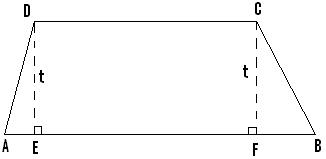
luas trapesium ABCD = luas segitiga ADE + luas persegi panjang CDEF + luas segitiga BFC
luas trapesium ABCD = (1/2 x AE x t) + (CD x t) + (1/2 x BF x t)
luas trapesium ABCD = 1/2 x t x (AE + 2 x CD + BF)
luas trapesium ABCD = 1/2 x t x (AE + 2 x EF + BF)
luas trapesium ABCD = 1/2 x t x (AE + EF + BF + EF)
luas trapesium ABCD = 1/2 x t x (AB + CD)
sumber : Turmudi & Aljupri. 2009. Pembelajaran Matematika. Program Peningkatan Kualifikasi Guru Madrasah dan Guru Pendidikan Agama Islam pada Sekolah. Jakarta : Direktorat Jenderal Pendidikan Islam. Departemen Agama.
Senin, 02 Januari 2012
Luas Layang-Layang
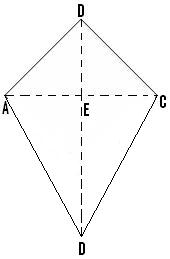
Layang-layang adalah segiempat yang sepasang sisi-sisinya yang berdekatan sama panjang.
berdasarkan sifat layang-layang, AB = BC dan CD = DA.
luas layang-layang ABCD = luas segitiga ABC + luas segitiga ADC
luas layang-layang ABCD = (1/2 x AC x EB) + (1/2 x AC x ED)
luas layang-layang ABCD = 1/2 x AC x (EB + ED)
luas layang-layang ABCD = 1/2 x AC x DB
karena AC dan BD masing-masing adalah diagonal-diagonal dari layang-layang ABCD, maka luas daerah layang-layang sama dengan setengah kali perkalian diagonal-diagonalnya.
sumber : Turmudi & Aljupri. 2009. Pembelajaran Matematika. Program Peningkatan Kualifikasi Guru Madrasah dan Guru Pendidikan Agama Islam pada Sekolah. Jakarta : Direktorat Jenderal Pendidikan Islam. Departemen Agama.
Luas Daerah Belah Ketupat

Belah ketupat adalah segiempat yang memiliki empat buah sisi yang panjangnya sama.
luas belah ketupat ABCD = luas segitiga ACD + luas segitiga ACB
luas belah ketupat ABCD = (1/2 x AC x ED) + (1/2 x AC x EB)
luas belah ketupat ABCD = 1/2 x AC x (ED + EB)
luas belah ketupat ABCD = 1/2 x AC x BD
karena AC dan BD masing-masing adalah diagonal dari belah ketupat ABCD, maka bila AC = d1 dan BD = d2
jadi, luas belah ketupat ABCD = 1/2 x d1 x d2
sumber : Turmudi & Aljupri. 2009. Pembelajaran Matematika. Program Peningkatan Kualifikasi Guru Madrasah dan Guru Pendidikan Agama Islam Pada Sekolah. Jakarta : Direktorat Jenderal Pendidikan Islam, Departemen Agama.
Luas Daerah Segitiga Secara Konsep

Secara konsep, luas daerah segitiga adalah banyaknya persegi satuan yang menutupi segitiga tersebut. Tetapi bila kita menggunakan definisi tersebut secara langsung, maka tentu tidak mudah, banyak kesulitan. oleh karena itu, cara untuk menentukan luas daerah suatu segitiga dapat menggunakan bantuan luas daerah persegi panjang atau persegi.
berikut ini prosesnya :
luas ABEF = luas segitiga AFC + luas segitiga ADC + luas segitiga BDC + luas segitiga BEC
karena luas segitiga AFC = luas segitiga ADC dan luas segitiga BDC = luas segitiga BEC, maka
luas ABEF = (2 x luas segitiga ADC) + (2 x luas segitiga BDC)
luas ABEF = 2 x (luas segitiga ADC + luas segitiga BDC)
luas ABEF = 2 x luas segitiga ABC
jadi, luas segitiga ABC = 1/2 x luas ABEF
karena, luas ABEF = AB x BE, dan karena BE = CD, maka
luas segitiga ABC = 1/2 x AB x CD
tampak dari gambar, bahwa AB adalah panjang alas dari segitiga ABC,
dan CD adalah tinggi dari segitiga ABC,
sehingga, luas segitiga ABC = 1/2 x alas x tinggi
sumber : Turmudi & Aljupri. 2009. Pembelajaran Matematika. Program Peningkatan Kualifikasi Guru Madrasah dan Guru Pendidikan Agama Islam pada Sekolah. Jakarta : Direktorat Jenderal Pendidikan Islam, Departemen Agama.
Kamis, 29 September 2011
Process for Solving Open Ended Math Questions
Open-ended math questions are problems that are able to be solved in more than one way. Students are required to explain their thinking when answering open-ended question. This method lets a teacher know whether her students grasp the reasoning behind basic math skills -- or simply mastered a formula. Often these questions take the form of a word problem whereby students provide a written response that contains the answer and process used to find that answer. Once students determine what the question is asking, there are multiple strategies to choose from that will help answer the question.
Kamis, 09 Juni 2011
Gradien
Jika suatu garis melalui titik A dan B, memiliki suatu kenaikan (perubahan tegak) sebesar a satuan dan perubahan mendatar sebesar b satuan, dikatakan bahwa garis itu mempunyai tanjakan a/b. Secara umu, untuk sebuah garis yang melalui titik A(x1, y1), dan B(x2, y2) dengan x1 tidak sama dengan x2, kemiringan (m) dari garis itu didefinisikan sebagai m = (y2 - y1)/(x2 - x1).
Kemiringan m adalah ukuran kecuraman suatu garis. Perhatikan bahwa garis mendatar mempunyai kemiringan nol. Garis yang naik ke kanan mempunyai kemiringan positif dan garis yang jatuh ke kanan mempunyai kemiringan negatif. Semakin besar kemiringannya, semakin curam garis tersebut. Sedangkan konsep kemiringan untuk garis tegak tidak mempunyai arti, karena akan menyangkut pembagian oleh nol. Karenanya, kemiringan untuk garis tegak dibiarkan tak terdefinisi.
Selasa, 05 April 2011
Mengapa mengalikan dua angka negatif menjadi positif?
Penjelasan umum :
Jika saya berkata "Makan", saya mempersilahkan anda untuk makan (positif), tetapi jika saya berkata "Jangan Makan", saya mengatakan kebalikannya (negatif).
Maka, jika saya berkata "Jangan Jangan Makan" , artinya saya berkata "Makan".
Penjelasan khusus :
Ingat kembali Garis Bilangan !!!


Sumber : http://www.mathsisfun.com/multiplying-negatives.html
Senin, 04 April 2011
what is wolframalpha?
Wolfram|Alpha introduces a fundamentally new way to get knowledge and answers—
not by searching the web, but by doing dynamic computations based on a vast collection of built-in data, algorithms, and methods.
Wolfram|Alpha's long-term goal is to make all systematic knowledge immediately computable and accessible to everyone.
Source : http://www.wolframalpha.com
Rabu, 27 Oktober 2010
Love is like a math problem
by XD Jennifer Dx
You start by making sure you have wrote the problem down correctly... even though most of the time you don't know what to do with it...
And when you first write it down it looks so complicated that you just want to quit. It has different Variables that are placed in it and there are so many different techniques in solving it... You just have the pleasure of finding the write one..
When you first start the process of solving it you realize that this might take forever to understand but you just want to try...
Through out the problem you add a couple things and subtract too, Multiply variables and Divide to make smaller variables... But when you look at the problem so far, its still looks just as scary as it was in the beginning.
Then Soon enough you find an answer... Something that makes sense, You Celebrate just a little because your finally done... but when you check your answer, Your spirits come crashing and your mood changes and you feel like giving up.
But someone comes over and tells you that you can do this... You should try again... Maybe start new...
So you try again... and again... and again, Until you stopped caring... and you realize that almost everyone around you has found the answer and your the only one left...
But for some stupid reason you try one more time... You look at the problem again... and realize since the beginning you have been writing it down wrong.
You see that you were adding things you shouldn't off, subtracted things you needed, multiplied variables that you needed, and you divided things that should of never become so simple.
But you try... and this time you make sure you start right... with the right problem. And you still feel better knowing that its a new problem to you. So you Add, Subtract, Multiply, and Divide... and you get an answer that is so Outrageous to everyone... but to you it makes sense. You simplify some things that you could live with out so that everyone is happy... and you take one more look in the book and find out that you have the right answer...
And you know that no matter what you cant tell anyone how you did it... that they have to find out of there own... because we all use different techniques. And since you finally got it... you look over to your friend and see that the whole time their doing the wrong thing... they even have the wrong problem... and you wonder how there not done because they started so much earlier then you... But you lean over anyway and say... Something to encourage them just like someone did to you...
So even though everyone gets the same problem not everyone gets the same answer...
And there will even be some who will never find an answer at all.
Source : http://www.best-love-poems.com/poems.php?id=1056930
Rabu, 02 Juni 2010
How to calculate the Area, Perimeter of a Polygon manually
Polygon Definition:
A polygon is a plane figure that is bounded by a closed path or circuit, composed of a finite sequence of straight line segments.
Polygon Formula:
Using length of a side :
Area of Polygon = ((side)² * N) / (4Tan(π / N))
Perimeter of Polygon = N * (side)
Using radius (circumradius) :
Area of Polygon = ½ * R² * Sin(2π / N)
Using apothem (inradius) :
Area of Polygon = A² * N * Tan(π / N)
where A = R * Cos(π / N)
Using apothem and length of a side :
Area of Polygon = (A * P) / 2
where A = side / (2 * Tan(π / N))
where,
N = Number of sides, A = Apothem, R = Radius, P = Perimeter
Polygon Example:
Case 1: Find the area and perimeter of a polygon with the length 2 and the number of sides is 4.
Step 1: Find the area.
Area = ((side)² * N) / (4Tan(π / N))
= ((2)² * 4) / (4 * Tan(3.14 / 4))
= (4 * 4) / 4 * Tan(0.785)
= 16 / 4 * 0.999
= 16 / 3.996
Area = 4.
Step 2: Find the perimeter.
Perimeter = (N * (side) = 4 * 2 = 8
Case 2: Find the area of a polygon with the given radius 2 and the number of sides is 5.
Step 1: Find the area.
Area = ½ * R² * Sin(2π / N)
= (0.5) * 2² * Sin(2 * 3.14 / 5)
= 0.5 * 4 * Sin(6.28 / 5)
= 2 * Sin(1.26)
= 2 * 0.95
Area = 1.9.
Case 3:Find the area of a polygon with the given radius 2 and the number of sides is 5 using Apothem.
Step 1: Find the apothem.
Apothem = R * Cos(π / N)
= 2 * Cos(3.14 / 5)
= 2 * Cos(0.63)
= 2 * 0.81
Apothem = 1.62.
Step 2: Find the area.
Area = A² * N * Tan(π / N)
= 1.62² * 5 * Tan(3.14 / 5)
= 2.62 * 5 * Tan(0.63)
= 13.1 * 0.73
Area = 9.5.
Case 4: Find the area of a polygon with the length 2 and the number of sides is 4 using Apothem.
Step 1: Find the apothem.
Apothem = side / (2 * Tan(π / N))
= 2 / (2 * Tan(π / 4))
= 2 / (2 * Tan(0.785))
= 2 / (2 * 0.999)
= 2 / 1.998
Apothem = 1.
Step 2: Find the perimeter.
Perimeter = (N * (side) = 4 * 2 = 8
Step 3: Find the area.
Area = (A * P) / 2
= (1 * 8) / 2
= 8 / 2
A polygon is a plane figure that is bounded by a closed path or circuit, composed of a finite sequence of straight line segments.
Polygon Formula:
Using length of a side :
Area of Polygon = ((side)² * N) / (4Tan(π / N))
Perimeter of Polygon = N * (side)
Using radius (circumradius) :
Area of Polygon = ½ * R² * Sin(2π / N)
Using apothem (inradius) :
Area of Polygon = A² * N * Tan(π / N)
where A = R * Cos(π / N)
Using apothem and length of a side :
Area of Polygon = (A * P) / 2
where A = side / (2 * Tan(π / N))
where,
N = Number of sides, A = Apothem, R = Radius, P = Perimeter
Polygon Example:
Case 1: Find the area and perimeter of a polygon with the length 2 and the number of sides is 4.
Step 1: Find the area.
Area = ((side)² * N) / (4Tan(π / N))
= ((2)² * 4) / (4 * Tan(3.14 / 4))
= (4 * 4) / 4 * Tan(0.785)
= 16 / 4 * 0.999
= 16 / 3.996
Area = 4.
Step 2: Find the perimeter.
Perimeter = (N * (side) = 4 * 2 = 8
Case 2: Find the area of a polygon with the given radius 2 and the number of sides is 5.
Step 1: Find the area.
Area = ½ * R² * Sin(2π / N)
= (0.5) * 2² * Sin(2 * 3.14 / 5)
= 0.5 * 4 * Sin(6.28 / 5)
= 2 * Sin(1.26)
= 2 * 0.95
Area = 1.9.
Case 3:Find the area of a polygon with the given radius 2 and the number of sides is 5 using Apothem.
Step 1: Find the apothem.
Apothem = R * Cos(π / N)
= 2 * Cos(3.14 / 5)
= 2 * Cos(0.63)
= 2 * 0.81
Apothem = 1.62.
Step 2: Find the area.
Area = A² * N * Tan(π / N)
= 1.62² * 5 * Tan(3.14 / 5)
= 2.62 * 5 * Tan(0.63)
= 13.1 * 0.73
Area = 9.5.
Case 4: Find the area of a polygon with the length 2 and the number of sides is 4 using Apothem.
Step 1: Find the apothem.
Apothem = side / (2 * Tan(π / N))
= 2 / (2 * Tan(π / 4))
= 2 / (2 * Tan(0.785))
= 2 / (2 * 0.999)
= 2 / 1.998
Apothem = 1.
Step 2: Find the perimeter.
Perimeter = (N * (side) = 4 * 2 = 8
Step 3: Find the area.
Area = (A * P) / 2
= (1 * 8) / 2
= 8 / 2
Area = 4.
Source : http://www.easycalculation.com/area/learn-polygon.php
Rabu, 12 Mei 2010
Dividing a fraction by a fraction
The cookie scenario below is an excellent example to visualize why
dividing a whole number by a fraction causes the answer to be
larger than the original whole number. But what about dividing a
fraction by a fraction? The scenario becomes incomprehensible when
the "5 cookies" become a half a cookie.
Do you have another example/scenario that can help students visualize
a problem such as:
1/3 / 1/2 = 2/3
The abstract concepts have been explained tremendously. Is there a
concrete way? If I have a third of a pie, and I want to divide that
dividing a whole number by a fraction causes the answer to be
larger than the original whole number. But what about dividing a
fraction by a fraction? The scenario becomes incomprehensible when
the "5 cookies" become a half a cookie.
Do you have another example/scenario that can help students visualize
a problem such as:
1/3 / 1/2 = 2/3
The abstract concepts have been explained tremendously. Is there a
concrete way? If I have a third of a pie, and I want to divide that
third of a pie by 1/2, why does the answer become 2/3 of the pie??
Answer :
Lots of people find this confusing. If you divide 5 by 2, the
answer is 2.5. If you divide 5 by 1/2, do you expect the same thing
as dividing by 2?
If you divide by a number bigger than 1, it always reduces the number.
If you divide by 1, it doesn't change anything. Does that make you
think that dividing by a fraction less than 1 should INCREASE the
number?
How many kids can you serve with 5 cookies if each kid gets 2 cookies?
You can serve 2 kids (with enough left over for 1/2 a kid).
How many kids can you serve with 5 cookies if each kid gets 1/2 a
cookie? That's 5 divided by 1/2.
Maybe you could think about it this way. For the 5/2 = 2.5 you
could think of how many 2-cookie servings you can make out of
5 cookies. You get two full 2-cookie servings plus half of a
2-cookie serving. For the 5/half = 10 you could think of how
many half-cookie servings you could get out of 5 cookies.
For the (1/3)/(1/2) = 2/3 it's probably clearer to write it as
(2/6)/(3/6) = 2/3 and ask how times you could get a (3/6)-cookie
serving out of 2/6 of a cookie. You can't! You get **zero**
(3/6)-cookie servings. But you can get PART OF A (3/6)-cookie
serving. In fact you get exactly "two thirds of a (3/6)-cookie
serving. I'll leave it up to you to decide whether what I just
said is incomprehensible.
It may be clearer to keep it (1/3)/(1/2) = 2/3. Then say,
"how many cookie-halves can you get out of a third of
a cookie?" The answer would then be, "You can't get ANY cookie-
halves out of a third of a cookie, BUT you CAN get two thirds of
a cookie-half from a third of a cookie.
Source : mathforum
Jumat, 22 Januari 2010
The Philosophy of Mathematics
The philosophy of mathematics is the branch of philosophy whose task is to reflect on, and account for the nature of mathematics. this is a special case of the task of epistemology which is to account for human knowledge in general. The philosophy of mathematics addresses such questions as : What is the basis for mathematical knowledge? What is the nature of mathematical truth? What characterises the truths of mathematics? What is the justification for their assertion? Why are the truth of mathematics necessary truths?.
A widely adopted approach to epistemology, is to assume that knowledge in any field is represented by a set of propositions, together with a set of procedures for verifying them, or providing a warrant for their assertion. On this basis, mathematical knowledge consists of a set of propositions together with their proofs. Since mathematical proofs are based on reason alone, without recourse to empirical data, mathematical knowledge is understood to be the most certain of all knowledge. Traditionally the philosophy of mathematics has seen its task as providing a foundationfor the certainty of mathematical knowledge. That is, providing a system into which mathematical knowledge can be cst to systematically establish its truth. This depends on an assumption, which is widely adopted, implicity if not explicity.
Assumption
The role of the philosophy of mathematics is to provide a systematic and absolutely secure foundation for mathematical knowledge, that is for mathematical truth. This assumption is the basis of foundationism, the doctrine that the function of philosophy of mathematics is ti provide certain foundations for the mathematical knowledge. Foundationism is bound up with the absolutist view of mathematical knowledge, for it regards the task of justifying this view to be central to the philosophy of mathematics.
Source :
Ernest, Paul. 1991. The Philosophy of Mathematics Education. London, UK : RoutledgeFalmer, Taylor & Francis Group.
A widely adopted approach to epistemology, is to assume that knowledge in any field is represented by a set of propositions, together with a set of procedures for verifying them, or providing a warrant for their assertion. On this basis, mathematical knowledge consists of a set of propositions together with their proofs. Since mathematical proofs are based on reason alone, without recourse to empirical data, mathematical knowledge is understood to be the most certain of all knowledge. Traditionally the philosophy of mathematics has seen its task as providing a foundationfor the certainty of mathematical knowledge. That is, providing a system into which mathematical knowledge can be cst to systematically establish its truth. This depends on an assumption, which is widely adopted, implicity if not explicity.
Assumption
The role of the philosophy of mathematics is to provide a systematic and absolutely secure foundation for mathematical knowledge, that is for mathematical truth. This assumption is the basis of foundationism, the doctrine that the function of philosophy of mathematics is ti provide certain foundations for the mathematical knowledge. Foundationism is bound up with the absolutist view of mathematical knowledge, for it regards the task of justifying this view to be central to the philosophy of mathematics.
Source :
Ernest, Paul. 1991. The Philosophy of Mathematics Education. London, UK : RoutledgeFalmer, Taylor & Francis Group.
Jumat, 06 Februari 2009
Tahap-Tahap Memecahkan Persoalan Secara Numerik
Ada enam tahap yang dilakukan dalam pemecahan persoalan dunia nyata dengan metode numeri, yaitu :
1. Permodelan
Ini adalah tahap pertama. Persoalan dunia nyata dimodelkan ke dalam persamaan matematika.
2. Penyederhanaan model
Model matematika yang dihasilkan dari tahap 1 mungkin saja terlalu kompleks, yaitu memasukkan banyak peubah (variabel) atau parameter. Semakin kompleks model matematikanya, semakin rumit penyelesaiannya. Mungkin beberapa andaian dibuat sehingga beberapa parameter dapat diabaikan. Contohnya, faktor gesekan udara diabaikan sehingga koefisien gesekan di dalam model dapat dibuang. Model matematika yang diperoleh dari penyederhanaan menjadi lebih sederhana sehingga solusinya akan lebih mudah diperoleh.
3. Formulasi numerik
Setelah model matematika yang sederhana diperoleh, tahap selanjutnya adalah memformulasikannya secara numerik, antara lain :
a. menentukan metode numerik yang akan dipakai bersama-sama dengan analisis galat awal (yaitu taksiran galat, penentuan ukuran langkah, dan sebagainya).
Pemilihan metode didasari pada pertimbangan :
- apakah metode tersebut teliti ?
- apakah metode tersebut mudah diprogram dan waktu pelaksanaannya cepat ?
- apakah metode tersebut tidak peka terhadap perubahan data yang cukup kecil ?
b. menyusun algoritma dari metode numerik yang dipilih.
4. Pemrograman
Tahap selanjutnya adalah menerjemahkan algoritma ke dalam program komputer dengan menggunakan salah satu bahasa pemrograman yang dikuasai.
5. Operasional
Pada tahap ini, program komputer dijalankan dengan data uji coba sebelum data yang sesungguhnya.
6. Evaluasi
Bila program sudah selesai dijalankan dengan data yang sesungguhnya, maka hasil yang siperoleh diinterpretasi. Interpretasi meliputi analisis hasil run dan membandingkannya dengan prinsip dasar dan hasil-hasil empirik untuk menaksir kualitas solusi numerik, dan keputusan untuk menjalankan kembali program sehingga memperoleh hasil yang lebih baik.
Sumber :
Munir, Rinaldi. 2006. Metode Numerik. Bandung : Informatika.
1. Permodelan
Ini adalah tahap pertama. Persoalan dunia nyata dimodelkan ke dalam persamaan matematika.
2. Penyederhanaan model
Model matematika yang dihasilkan dari tahap 1 mungkin saja terlalu kompleks, yaitu memasukkan banyak peubah (variabel) atau parameter. Semakin kompleks model matematikanya, semakin rumit penyelesaiannya. Mungkin beberapa andaian dibuat sehingga beberapa parameter dapat diabaikan. Contohnya, faktor gesekan udara diabaikan sehingga koefisien gesekan di dalam model dapat dibuang. Model matematika yang diperoleh dari penyederhanaan menjadi lebih sederhana sehingga solusinya akan lebih mudah diperoleh.
3. Formulasi numerik
Setelah model matematika yang sederhana diperoleh, tahap selanjutnya adalah memformulasikannya secara numerik, antara lain :
a. menentukan metode numerik yang akan dipakai bersama-sama dengan analisis galat awal (yaitu taksiran galat, penentuan ukuran langkah, dan sebagainya).
Pemilihan metode didasari pada pertimbangan :
- apakah metode tersebut teliti ?
- apakah metode tersebut mudah diprogram dan waktu pelaksanaannya cepat ?
- apakah metode tersebut tidak peka terhadap perubahan data yang cukup kecil ?
b. menyusun algoritma dari metode numerik yang dipilih.
4. Pemrograman
Tahap selanjutnya adalah menerjemahkan algoritma ke dalam program komputer dengan menggunakan salah satu bahasa pemrograman yang dikuasai.
5. Operasional
Pada tahap ini, program komputer dijalankan dengan data uji coba sebelum data yang sesungguhnya.
6. Evaluasi
Bila program sudah selesai dijalankan dengan data yang sesungguhnya, maka hasil yang siperoleh diinterpretasi. Interpretasi meliputi analisis hasil run dan membandingkannya dengan prinsip dasar dan hasil-hasil empirik untuk menaksir kualitas solusi numerik, dan keputusan untuk menjalankan kembali program sehingga memperoleh hasil yang lebih baik.
Sumber :
Munir, Rinaldi. 2006. Metode Numerik. Bandung : Informatika.
Langganan:
Postingan (Atom)
